
Introduction
Road safety and traffic control are important for maintaining public order and protecting citizens. In Maharashtra, traffic regulation is primarily governed by the Motor Vehicles Act, 1988, as amended by the Motor Vehicles (Amendment) Act, 2019, along with the Maharashtra Motor Vehicles Rules, 1989.
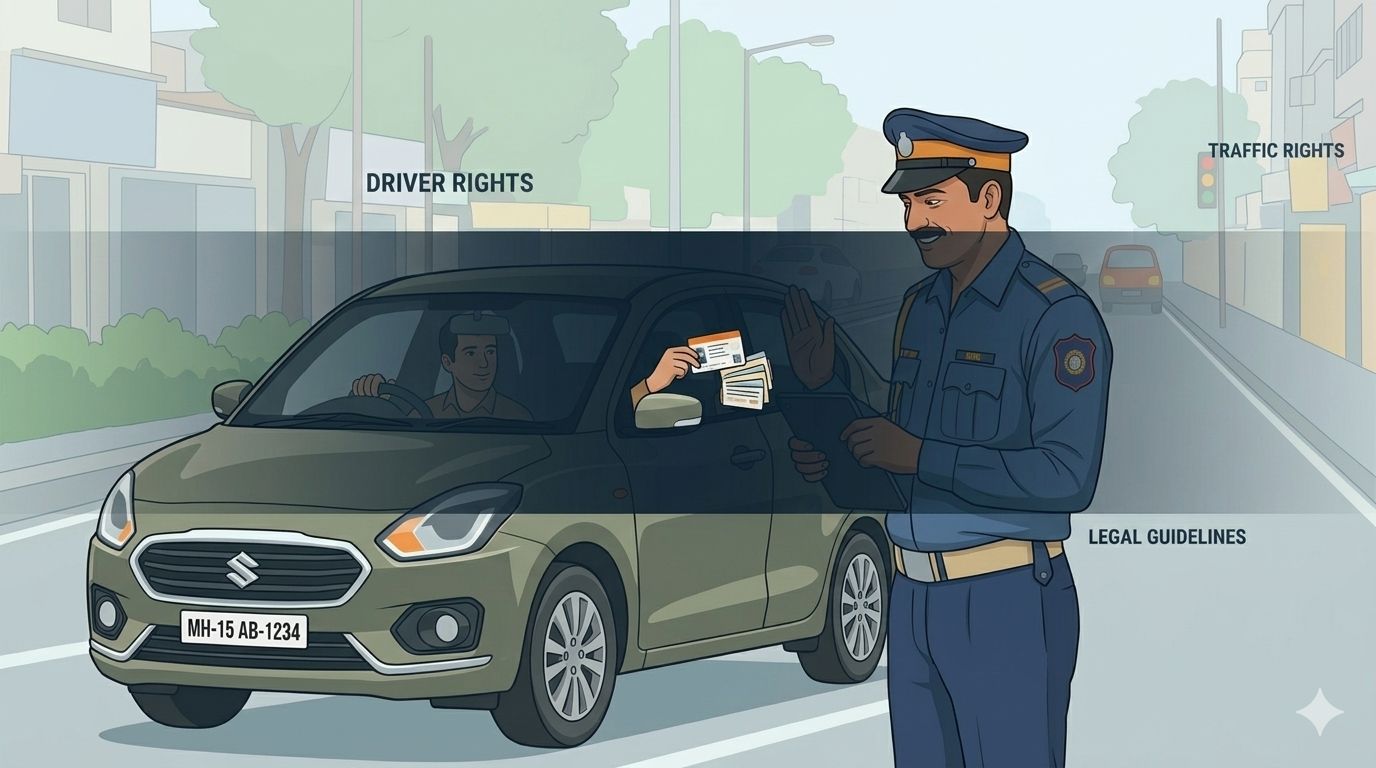
The objective of this article is to explain, in simple terms, the legal duties of a driver, the powers of traffic police, and the rights of an ordinary citizen when stopped for a traffic check
Legal framework
The authority of police officers to stop and inspect vehicles is derived primarily from the Motor Vehicles Act, 1988 (as amended in 2019). The Act empowers traffic police and authorized officers to regulate road safety, inspect documents, and take action against violations. Additionally, certain provisions of the Criminal Procedure Code, 1973 (CrPC) may apply in cases involving arrest, detention, or investigation of serious offences. State-specific Motor Vehicle Rules further supplement these powers.
Duties of the Driver When Stopped by Police
When a police officer signals a vehicle to stop, the driver is legally required to comply with such direction. The Motor Vehicles Act, 1988 places certain responsibilities on drivers to ensure cooperation with traffic authorities and the proper enforcement of road safety regulations.
The following are the primary duties of a driver:
Duty to Stop the Vehicle
A driver must stop the vehicle when directed by a police officer in uniform or any authorized officer regulating traffic. Failing to stop when signaled may amount to a traffic violation and can attract legal penalties.
Duty to Produce Driving Licence
Under the Motor Vehicles Act, a driver must produce their driving licence when demanded by a police officer or other authorized authority.
Driving Licence – Legal Requirement and Situations
a] Driver Must Possess a Valid Driving Licence
Under Section 3 of the Motor Vehicles Act, 1988, no person shall drive a motor vehicle in any public place unless they hold an effective and valid driving licence authorizing them to drive that category of vehicle.
b] Duty to Produce Driving Licence
According to Section 130 of the Motor Vehicles Act, a driver must produce the driving licence when demanded by a police officer in uniform or any authorized officer.
c] Situation 1 – Driver Has Licence but Forgot to Carry It
- If the driver has a valid licence but is not carrying it at the time of checking, the officer may ask the driver to produce it later at a specified police station.
- This usually must be done within the prescribed period (generally up to 15 days).
- This situation is not treated as driving without a licence.
d] Situation 2 – Driver Shows Digital Licence
- A driver may produce the licence digitally through government-recognized platforms such as DigiLocker or mParivahan.
- These digital documents are legally accepted for verification by traffic authorities.
e] Situation 3 – Driver Does Not Have a Valid Licence
- If the driver does not possess a valid driving licence, it becomes an offence under Section 3 read with Section 181 of the Motor Vehicles Act.
- The driver may be liable to a fine up to ₹5000
Duty to Produce Vehicle Documents
The driver may also be required to produce other vehicle-related documents, including:
- Registration Certificate (RC)
- Insurance Certificate
- Pollution Under Control (PUC) Certificate
- Permit (in case of transport vehicles)
These documents may be produced either in physical form or through government-recognized digital platforms such as DigiLocker or mParivahan, as permitted by government notifications.
Duty to Allow Inspection of the Vehicle
A driver must allow an authorized officer to inspect the vehicle if required, especially in cases where the officer suspects a violation of traffic rules, vehicle safety regulations, or documentation requirements.
Duty to Follow Lawful Instructions
Drivers are required to comply with lawful directions given by traffic police officers. This may include instructions related to stopping the vehicle, moving the vehicle, parking regulations, or traffic control measures.
Duty to Cooperate with Law Enforcement
Drivers must cooperate with police officers performing their official duties and should avoid any act that obstructs or interferes with the enforcement of traffic laws
Rights of the Driver When Stopped by Police
While drivers have certain duties under the law, they also possess rights that protect them from arbitrary or unlawful actions by law enforcement authorities. These rights arise from statutory provisions and general legal principles governing police conduct.
Right to Know the Identity of the Officer
A driver has the right to know the identity and designation of the police officer stopping the vehicle. Police officers performing traffic duties are required to be in uniform and properly identifiable while exercising powers under the Motor Vehicles Act, 1988.
Right to Receive an Official Challan
If a driver commits a traffic violation, the police officer may impose a fine according to the provisions of the Motor Vehicles Act. However, the driver has the right to receive an official challan or receipt for any penalty imposed. Penalties for general offences are governed by Section 177 of the Motor Vehicles Act, 1988.
Right to Produce Documents Later
Under Section 130 of the Motor Vehicles Act, 1988, if a driver is unable to produce certain documents such as the driving licence or registration certificate immediately, the driver may be allowed to produce the documents later at a specified police station within the prescribed period.
Right Against Unlawful Demand of Money
A police officer cannot demand arbitrary or unofficial payments. Any fine must be imposed in accordance with the legal provisions of the Motor Vehicles Act. If a driver is asked to pay a fine, the driver has the right to demand a proper challan issued under the law.
Right Against Harassment or Abuse
Police officers must perform their duties in accordance with law and professional conduct. If a driver is subjected to harassment, abuse, or unlawful behaviour by a police officer, the driver may file a complaint before senior police authorities or seek legal remedies under the applicable law.
Right to Challenge an Unlawful Action
If a driver believes that a traffic penalty or police action is unlawful, the driver may challenge the action before the competent authority or court in accordance with legal procedures
Judicial Protection of Citizens’ Rights
D.K. Basu v. State of West Bengal (1997)
In this case, the Supreme Court of India noticed that people were sometimes being harassed or mistreated during police actions. To prevent misuse of power, the Court issued guidelines that police officers must follow while dealing with citizens.
The Court emphasized that police must act within the law and respect the dignity and rights of individuals
Powers of the Police Officer When Stopping a Vehicle
Traffic police officers are empowered under the Motor Vehicles Act, 1988 to regulate traffic and enforce road safety laws. While exercising their authority, police officers must act within the limits prescribed by law.
Power to Stop a Vehicle
Police officers have the authority to signal a vehicle to stop for the purpose of checking documents, regulating traffic, or investigating a suspected violation of traffic laws.
Power to Demand Documents
Under Section 130 of the Motor Vehicles Act, 1988, a police officer in uniform may require the driver to produce:
- Driving Licence
- Registration Certificate (RC)
- Insurance Certificate
- Pollution Under Control (PUC) Certificate
- Permit (for transport vehicles)
Power to Issue a Challan
If a driver violates traffic rules, the officer may issue a challan (fine) according to the provisions of the Motor Vehicles Act.
Power to Seize Driving Licence
Under Section 206 of the Motor Vehicles Act, 1988, a police officer may seize the driving licence of a driver in certain situations, such as dangerous driving or serious traffic violations.
Power to Impound the Vehicle
Under Section 207 of the Motor Vehicles Act, 1988, a police officer may detain or impound a vehicle if it is being used without proper registration, permit, or in violation of legal requirements
Limitations on Police Authority
Although police officers have certain powers under the Motor Vehicles Act, 1988, these powers must be exercised within legal limits. The police cannot act arbitrarily or misuse their authority while dealing with citizens.
Police Cannot Demand Unofficial Money
A police officer cannot demand cash or any amount of money without issuing an official challan or receipt. Any traffic fine must be imposed according to the provisions of the Motor Vehicles Act.
Police Cannot Misbehave or Abuse the Driver
Police officers are expected to maintain professional conduct. They cannot abuse, threaten, or harass a driver without lawful reason.
Police Cannot Seize Documents Without Legal Basis
Police officers cannot confiscate documents such as the driving licence or registration certificate unless it is permitted under the relevant provisions of law, such as Section 206 of the Motor Vehicles Act.
Police Cannot Impound a Vehicle Without Legal Grounds
A vehicle cannot be detained or impounded unless the situation falls under the provisions of Section 207 of the Motor Vehicles Act, such as lack of registration, permit, or other legal violations.
Police Cannot Act Beyond Legal Authority
Traffic police must act within the powers granted by law and cannot exercise authority in a way that violates the rights of citizens
Conclusion
Road safety and traffic discipline are essential for maintaining order on public roads. When a police officer stops a vehicle, the interaction between the driver and the officer is governed by the provisions of the Motor Vehicles Act, 1988 and related legal rules. Drivers are expected to follow lawful instructions, carry the necessary documents, and cooperate with authorities responsible for enforcing traffic regulations.At the same time, the law also recognizes that citizens have certain rights that protect them from arbitrary actions or misuse of authority. Police officers must exercise their powers responsibly, maintain professional conduct, and ensure that enforcement actions are carried out strictly in accordance with the law.Understanding these legal duties, rights, and powers helps create a balanced relationship between citizens and law enforcement authorities. When drivers are aware of their responsibilities and rights, they can handle such situations calmly and confidently while ensuring that the rule of law is respected.Therefore, legal awareness plays an important role in promoting responsible driving, transparency in enforcement, and mutual respect between the public and traffic authorities.
References
- Motor Vehicles Act, 1988 – Section 3 (Necessity for Driving Licence)
https://indiankanoon.org/doc/1936320/ - Motor Vehicles Act, 1988 – Section 130 (Duty to Produce Licence and Documents)
https://indiankanoon.org/doc/244548/ - Motor Vehicles Act, 1988 – Section 177 (General Provision for Punishment of Offences)
https://indiankanoon.org/doc/319463/ - Motor Vehicles Act, 1988 – Section 181 (Driving Without Licence)
https://indiankanoon.org/doc/1068534/ - Motor Vehicles Act, 1988 – Section 206 (Power of Police Officer to Seize Driving Licence)
https://indiankanoon.org/doc/1854730/ - Motor Vehicles Act, 1988 – Section 207 (Power to Detain Vehicles)
https://indiankanoon.org/doc/1843379/ - D.K. Basu v. State of West Bengal (1997) – Supreme Court guidelines on police powers
https://indiankanoon.org/doc/501198