Introduction:
Corporate personality is one of the most essential principles in company law. It refers to the legal recognition of a company as an independent entity, separate from the individuals who constitute it. In simple terms, the law treats a company as a “person” capable of owning property, entering into contracts, and initiating or defending legal proceedings in its own name. This concept is founded on the Doctrine of Separate Legal Personality, which L.C.B. Gower described as the complete distinction between a company and its members.
The emergence of this principle was driven by the needs of commercial development and economic expansion. By granting a company its own legal identity, the law ensures that the liabilities and obligations of the business are borne by the company itself, rather than by its shareholders. For instance, creditors can claim against the company’s assets but cannot generally proceed against the personal property of its members. Similarly, the company is not responsible for acts carried out by its members in their personal capacity. This article aims to explore the meaning of corporate personality and critically examine the various theories that attempt to explain it.
Historical Development of Corporate Personality:
The concept of corporate personality has roots in ancient legal traditions. Early traces can be found in Roman law and Hindu law, where certain forms of collective identity were acknowledged, although not in a fully developed legal sense. Religious texts, including those from early Christian traditions, also reflected ideas of group identity and collective responsibility.
However, the modern and structured development of corporate personality took place under English common law. From the 17th century onwards, the law gradually began recognizing corporations as entities distinct from their members. The most significant milestone in this evolution is the landmark case of Salomon v. Salomon & Co. Ltd. In this case, the House of Lords firmly established that a company has a separate legal identity, even when it is controlled by a single individual or a small group of shareholders.
The judgment clarified that once a company is legally incorporated, it becomes an independent legal person with its own rights and liabilities. This decision laid the foundation of modern company law and has influenced legal systems across the world.
Theories of Corporate Personality:
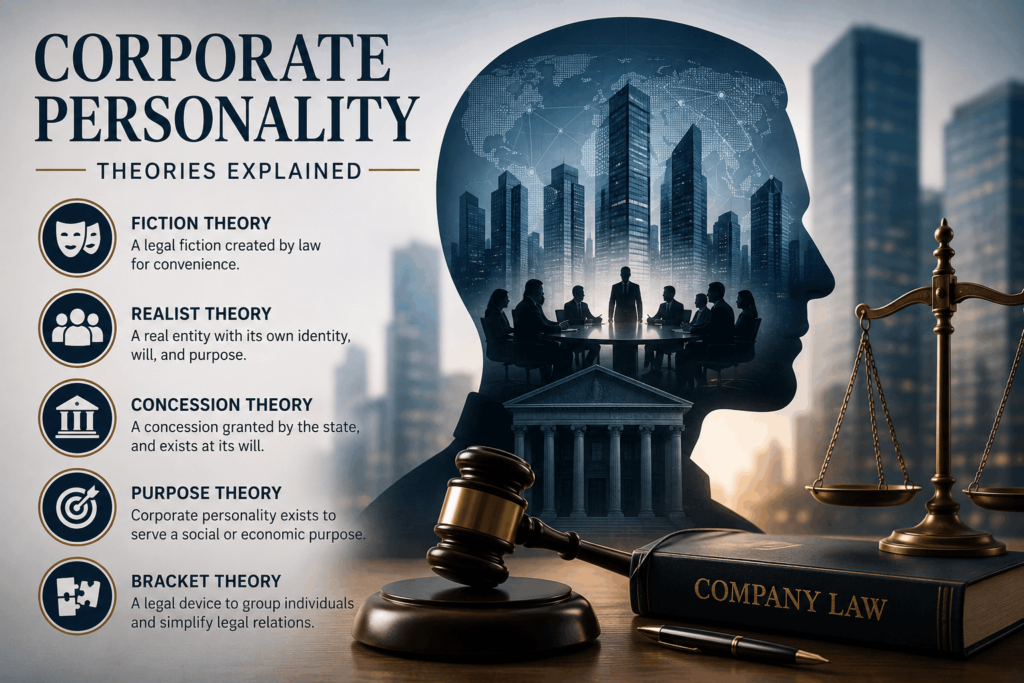
Over time, jurists and legal scholars have attempted to explain the nature of corporate personality through different theoretical approaches. No single theory has been universally accepted as absolute, mainly because courts tend to adopt a practical approach rather than strictly adhering to any one theory. The five major theories are the Fiction Theory, Realist Theory, Concession Theory, Purpose Theory, and Bracket Theory.
Fiction Theory:
The Fiction Theory is associated with jurists such as Savigny, Salmond, Blackstone, and Holland. According to this theory, a corporation does not possess a real existence; rather, it is an artificial construct created by law. The law treats the corporation as a person purely for convenience and to facilitate legal and commercial transactions.
Under this view, corporate personality is not inherent but is assigned by legal recognition. This enables corporations to function effectively in areas such as property ownership, contractual relations, and litigation.
Realist Theory:
Despite its usefulness, this theory has been criticized for being overly simplistic. It fails to account for the practical realities of modern corporations, which have significant social and economic influence.
The Realist Theory, developed by the German jurist Gierke and supported by scholars like Maitland and Beseler, offers a contrasting perspective. It argues that a corporation is not merely a legal fiction but a real entity with its own identity, will, and purpose.
According to this theory, a group or organization has a collective existence that is distinct from the individuals who compose it. Corporations function as independent units, making decisions and carrying out activities that go beyond the actions of individual members.
This theory emphasizes the practical importance of corporations in society. They contribute to economic development, generate employment, and play a vital role in various sectors. Therefore, recognizing them as real entities ensures accountability and proper governance.
Concession Theory:
The Concession Theory is based on the idea that corporate personality is granted by the state. Jurists like Savigny, Salmond, and Dicey supported this approach. According to this theory, a corporation exists only because the state allows it to exist.
Corporate personality, therefore, is not a natural right but a privilege. In return for this privilege, corporations are expected to fulfill certain obligations, such as contributing to economic growth, generating employment, and paying taxes.
The theory also implies that the state has the authority to regulate, control, or even dissolve corporations if they fail to meet their responsibilities. Thus, corporate existence is closely linked to state approval.
Purpose Theory:
The Purpose Theory, proposed by Brinz, focuses on the objective or function of a corporation. It suggests that a legal personality should be granted only when the corporation serves a meaningful social or economic purpose.
According to this view, the recognition of corporate personality is justified only when it contributes to public welfare, supports economic progress, or benefits society in some way. This theory rejects the idea that corporate personality is automatic or inherent.
Instead, it emphasizes that legal recognition should be based on the usefulness and relevance of the corporation’s activities.
Bracket Theory:
The Bracket Theory, introduced by Ihering, presents a more technical perspective. It considers corporate personality as a legal mechanism used to simplify complex relationships among individuals.
According to this theory, the rights and duties of a corporation actually belong to its members, but for the sake of convenience, the law groups them under a single entity. This makes legal processes more efficient and manageable.
Hohfeld further supported this idea by stating that only human beings are true legal persons, and corporate personality is merely a procedural tool used by law to organize collective activities.
Conclusion:
In conclusion, corporate personality is a fundamental concept that enables companies to operate as independent legal entities. The various theories of corporate personality provide different perspectives on its nature and purpose. While the Fiction Theory views it as a legal construct, the Realist Theory considers it a genuine entity. The Concession Theory highlights the role of the state, whereas the Purpose Theory focuses on the social utility of corporations. The Bracket Theory, on the other hand, treats it as a legal convenience.
A proper understanding of these theories is essential for interpreting company law and addressing modern challenges. It also helps in ensuring that corporations function responsibly while balancing economic growth with societal interests.